Style
How to Choose the Perfect Lamp Table for Your Living Room
Oct
Summary: A lamp table is one of the smallest pieces of furniture in a living room, yet it has an outsized effect on comfort, lighting and the overall look of the space. This guide explains how to choose the perfect lamp table for your living room by getting the height right against your sofa arm, selecting a top size that holds a lamp and a drink, and choosing a material and finish that sits comfortably with the rest of your scheme. It also covers styling, storage, common buying mistakes and a practical checklist. Evans of High Wycombe has been making bespoke sofas and living room furniture for decades, so the advice below reflects how real British homes are furnished and used.
A lamp table is judged almost entirely on one relationship: its height against the arm of the sofa or chair beside it. Get that measurement within a few centimetres and the table becomes an effortless part of daily life. Get it wrong and every cup, book and remote control becomes a small exercise in reaching and balancing. Learning how to choose the perfect lamp table for your living room is therefore less about following trends and more about measuring your seat, understanding your lamp and thinking about how the surface will actually be used.
Evans of High Wycombe manufactures bespoke sofas, chairs and dining furniture in Buckinghamshire, and also offers living room pieces including lamp tables, coffee tables, TV units and bookcases. That matters because a lamp table rarely works in isolation. It has to sit beside a sofa, relate to a coffee table and feel part of the same room. If you are planning to buy lamp table furniture alongside a new sofa or armchair, choosing both together gives the best chance of getting the height, scale and finish right first time.
Consider the Size and Layout of Your Living Room
The first decision is not style but footprint. A lamp table only needs to hold a lamp, a drink and perhaps a book or a phone, so a top somewhere between 40cm and 50cm across is enough for most living rooms. Anything wider begins to behave like a small coffee table and starts eating into the space around it.
Measure the gap between the end of your sofa and the nearest wall, doorway or walkway. You want at least 60cm of clear space to walk past comfortably, and more if the table sits on a main route through the room. In narrow rooms, a round top or a rectangular table placed side on to the sofa uses less depth than a square design.
The shape of the room also guides the shape of the table. Round tables suit walkways and rooms with children because there is no corner at hip height. Square tops sit neatly against walls and sofa arms, while rectangular tops are useful when a lamp and a small stack of books need to share the surface.
Choose the Right Lamp Table Height
Height is the measurement that decides whether a lamp table works or not. Standard sofa arm heights in the UK commonly fall between 55cm and 65cm, which is why most lamp tables are built between 50cm and 65cm high. The table top should sit level with the sofa arm or up to about 5cm below it.
Measure from the floor to the top of the sofa arm, not to the top of the cushion. Low modern sofas may have arms closer to 50cm, while traditional rolled arms can reach 70cm. If your sofa has no meaningful arm, use the seat cushion height as the reference and aim for a table top around 10cm to 15cm above it.
The lamp matters as much as the table. When you are seated, the bottom edge of the lampshade should sit roughly at or just below eye level, around 100cm to 110cm from the floor, so you see soft light rather than a bare bulb. A lower table needs a taller lamp, and a taller table works with a shorter lamp. Add the table height to the lamp height before you buy and compare the total with your seated eye level.
Explore Different Lamp Table Styles and Designs
Square and rectangular four legged tables are the most common and most stable choice. They are easy to position beside a sofa and suit almost any room. Round tables soften a room and reduce the risk of knocks in tight spaces. Nest of tables give you flexible surfaces without permanent floor footprint, which suits smaller living rooms and occasional entertaining.
Pedestal and cross base designs bring a more contemporary look and can feel lighter in a compact room. Tables with a lower shelf add storage for books or magazines while keeping the top clear for the lamp. A drawer is useful beside a reading chair for glasses, remotes and coasters.
Because Evans of High Wycombe makes bespoke seating, there is also the option to have a lamp table made to suit the scale of a handmade sofa or armchair. A bespoke piece can be sized to the centimetre, which is particularly useful in period properties or rooms with awkward alcoves.
Select the Best Material for Your Interior
The material affects how the table looks, how it wears and how much maintenance it needs. Solid wood brings warmth and ages gracefully, and a real wood surface can be sanded and refinished if it picks up marks. Oak and walnut are the most popular choices for British living rooms because they sit comfortably with both traditional and contemporary schemes.
Glass tops keep sightlines open and let the floor or rug show through, which helps in a narrower room. Glass is also easy to wipe clean, although it shows fingerprints and needs a stable base. Metal frames offer durability and a modern or industrial edge, while high gloss and painted finishes suit sharper contemporary interiors.
| Material | Best for | Watch out for |
|---|---|---|
| Solid oak or walnut | Warm, traditional and transitional rooms; long term durability | Can mark if drinks are placed down without a coaster; needs occasional oiling |
| Glass top with metal or wood base | Smaller rooms and open, light schemes | Shows smudges; needs a sturdy frame to avoid wobble |
| Painted or high gloss | Contemporary rooms and easy cleaning | Chips can be difficult to touch in; can look cold without soft accessories |
| Marble or stone top | Statement schemes and luxury interiors | Heavy; can chip at edges; needs coasters to prevent etching |
Match Your Lamp Table with Existing Furniture
A lamp table that echoes something else in the room always feels more settled. Look at the wood tone of your coffee table, the finish on your TV unit and the legs of your sofa. If your existing pieces are light oak, a dark walnut lamp table may look disconnected unless it is repeated elsewhere in the scheme.
Finish is as important as species. A matte lacquer sits well with painted furniture, while a high gloss surface pairs naturally with glass and chrome. If you are buying a bespoke sofa from Evans of High Wycombe, ask about having the lamp table finished to relate to the sofa legs or the coffee table. That level of coordination is difficult to achieve when pieces are bought separately from different ranges.
Scale matters too. A small lamp table beside a large, deep sofa can look lost, while an oversized table can crowd a compact armchair. The table should feel like a natural extension of the seat beside it, not a separate object that happens to be nearby.
Consider Storage and Practical Features
A lamp table is small, so every feature has to earn its place. A lower shelf adds storage without adding footprint, which matters in terraced houses and flats where floor space is tight. A single drawer keeps small items out of sight and protects the top surface from clutter.
Stability is a practical feature that is often overlooked. Lamps raise the centre of gravity, so a wide footprint, rigid joints and a heavier base relative to the top all matter. Tables that wobble slightly when new tend to loosen further with use. On older floorboards, adjustable feet or felt pads help prevent rocking.
Cable routing is another practical consideration. A lamp table needs a socket within reach, and a cable trailing across a walkway is both untidy and a trip hazard. Position the table close to a wall socket or plan a discreet route behind the sofa. If the table has a lower shelf, the cable can often be routed down the back leg and along the skirting.
Choose the Right Colour and Finish
Colour is where a lamp table can either blend in or become a quiet focal point. Neutral finishes such as natural oak, soft grey, cream and clear glass are the easiest to live with and the simplest to coordinate with changing soft furnishings. They allow the lamp and accessories to do the talking.
Darker finishes, including walnut, charcoal and deep painted tones, add definition and suit rooms with pale walls and plenty of daylight. On a dark table, pale objects stand out; on a light table, deeper tones give definition. High gloss finishes reflect light and can make a small room feel larger, but they also show dust and fingerprints more readily.
If the table sits beside a sofa with wooden legs, repeating that wood tone on the lamp table is a simple way to create cohesion. If the sofa has metal legs, a lamp table with a matching metal frame will feel intentional rather than accidental.
How to Style Your Lamp Table with Decorative Accessories
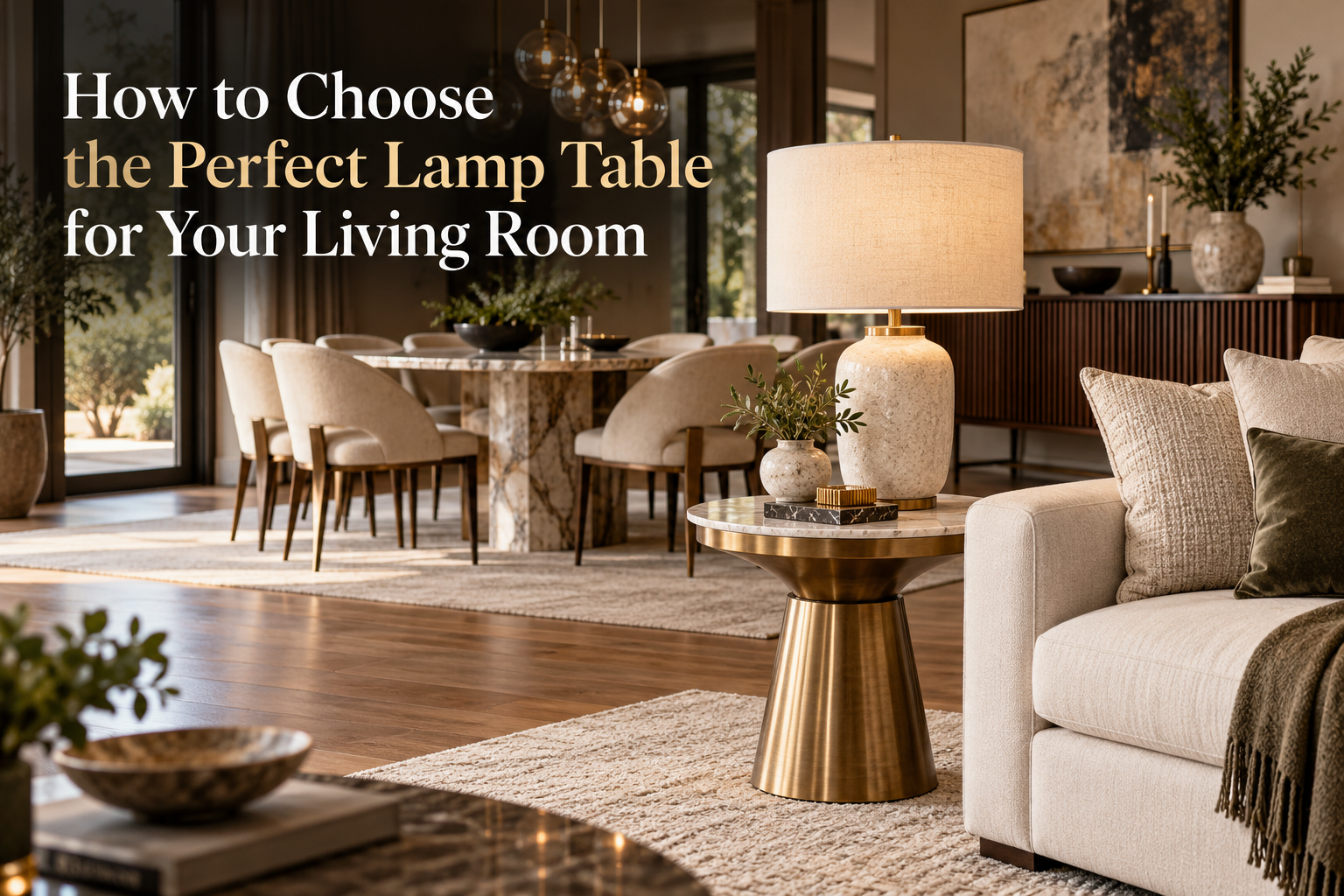
Interior designers style lamp tables with a simple principle: the lamp comes first and everything else is secondary. Choose a lamp in proportion to the table, add no more than two or three supporting objects at varied heights, and leave at least a third of the surface clear for a drink or a book.
Work in layers of height. The lamp is the tallest point, a vase or small plant sits at medium height, and a stack of books or a shallow dish sits low. Keep the arrangement to the back and one side of the table, leaving the front edge nearest the seat clear. That clear zone is where a mug or glass will go, and protecting it keeps the table useful rather than purely decorative.
Contrast stops a styled lamp table from looking flat. A glossy table works well with matte ceramics or a linen shade. A rustic wooden table suits a sleek metal lamp or a smooth glass vase. Resist the urge to fill every centimetre. Two or three carefully chosen pieces alongside the lamp almost always look better than five or six.
Common Mistakes to Avoid When Buying a Lamp Table
The most common mistake is a height mismatch against the adjacent seat. A table that sits too low forces a deliberate reach downwards, and the difference in how often drinks are knocked over is not subtle. A table that sits too high makes you lift a cup over the sofa arm, which is just as awkward.
The second mistake is choosing a top that is too small. A 40cm square top is fully occupied by a lamp base of any presence, leaving everything else balanced on the edge. Going to 45cm or 50cm gives room for a lamp at the back and a clear zone at the front.
Other frequent errors include buying a lamp that is out of proportion to the table, ignoring cable routing, and choosing a lightweight table with a small base footprint for a tall, top heavy lamp. Buyers who choose on appearance alone tend to replace within a couple of years; buyers who check the height against their sofa rarely do.
Final Tips for Choosing the Perfect Lamp Table
Before you order, measure your sofa arm height, measure your lamp base and total lamp height, and check that the table top leaves space for a drink alongside the lamp. Confirm the base width and overall stability, and make sure there is a practical route for the cable. Style comes after these practical checks, not before.
Buying checklist
Use this checklist before you commit to a lamp table.
- Sofa or chair arm height measured from the floor to the top of the arm.
- Table height chosen to sit level with the arm or up to 5cm below it.
- Table top at least 40cm across, ideally 45cm to 50cm for a lamp plus a drink.
- Lamp base takes up no more than about a third of the tabletop.
- Bottom of the lampshade sits at or just below seated eye level.
- Frame is stable with a wide footprint and rigid joints.
- Cable can reach a socket without crossing a walkway.
- Finish relates to the wood tone or metal finish of existing furniture.
- At least 60cm of clear walkway around the table.
- Room left on the surface for everyday items, not just the lamp.
FAQs
What height should a lamp table be beside a sofa?
A lamp table should sit level with the sofa arm or up to about 5cm below it. UK sofa arms commonly measure between 55cm and 65cm from the floor, so most lamp tables fall between 50cm and 65cm high. Always measure your own sofa rather than relying on a standard figure.
How big should a lamp table top be?
A top of at least 40cm across is the minimum for a lamp base plus a drink, but 45cm to 50cm is more practical for everyday use. The lamp base should take up no more than about a third of the surface, leaving the rest clear for a mug, phone or book.
Should the lamp table match the coffee table?
It does not have to match exactly, but it should relate in wood tone, finish or style. A lamp table that echoes the coffee table or the sofa legs will feel part of the same scheme rather than an afterthought. Evans of High Wycombe can finish bespoke pieces to coordinate with existing furniture.