Style
How Can You Style a Sofa Console Table Without Overdecorating?
Sep
A console table behind a sofa can be one of those small pieces of furniture that quietly changes the whole appearance of a living room. It fills an empty area, gives the sofa a more finished look, and creates a useful surface for everyday items. However, there is an easy mistake to make: adding too many decorations simply because there is space available.
A well-styled console table should feel intentional rather than crowded. Every item should have a reason for being there, whether it adds height, texture, light, colour, or practical value. The goal is not to cover every inch of the table. Instead, it is to create a balanced arrangement that works naturally with the sofa and the rest of the room.
The good news is that styling one does not need to be complicated. With a few simple decisions about proportion, spacing, materials, and function, you can make the area behind your sofa look polished without making it feel busy.
Start With the Sofa and the Room
Before placing anything on the table, look at the room as a whole. The console should not be treated as a separate display area. It is part of the wider furniture arrangement, so its appearance needs to relate to the sofa, rug, lighting, walls, and other pieces nearby.
Consider the visual weight of your sofa first. A large, deep sofa can handle a stronger console arrangement, while a slimmer sofa may look better with a lighter and more open display. The same idea applies to colour. If the seating already has a strong pattern or rich colour, the table can be styled more simply.
The wall behind the sofa also matters. A blank wall gives you more freedom, while a wall with artwork, shelving, or other features may already have enough visual interest. Taking a few moments to assess the entire space prevents the console table from looking like an unrelated collection of accessories.
Keep the Surface Mostly Open
One of the simplest ways to avoid overdecorating is to leave some of the tabletop visible. A completely covered surface can make a room feel visually heavy, especially when the table is already positioned behind a large sofa. Empty space is not wasted space. It helps the objects you do choose to stand out and gives the whole arrangement room to breathe.
Think about grouping a few carefully chosen items instead of spreading lots of small decorations across the full width. For example, one side might feature a lamp and a small decorative object, while the other side remains relatively open. This approach also makes cleaning easier and allows you to change the arrangement without starting from scratch.
Follow a Simple Height Pattern
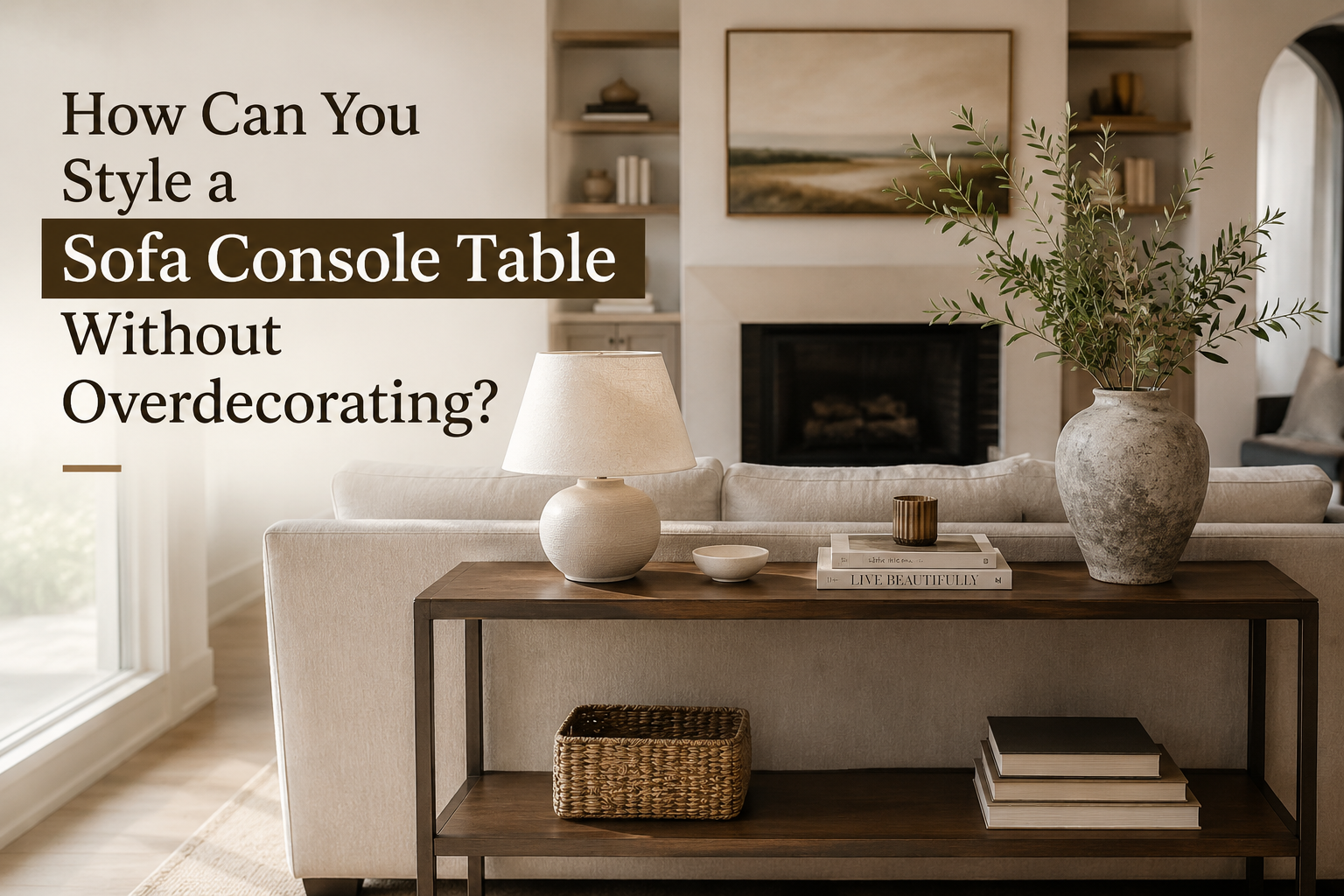
Different heights can make a console display look more interesting without requiring lots of accessories. Start with one taller item as an anchor. This could be a table lamp, a tall vase, or another vertical feature. Then add one or two shorter pieces beside it. The difference in height creates movement and stops the arrangement from looking flat.
Avoid making every object the same height. When several items sit at exactly the same level, the display can look rigid and overly planned. At the same time, do not create a dramatic collection of tall objects that compete with the sofa or artwork behind it. The tallest piece should support the room rather than dominate it. A useful way to think about height is to create a gentle rise and fall across the tabletop rather than a straight line.
Choose a Clear Focal Point
A console table does not need several attention-grabbing pieces. Usually, one main feature is enough. Your focal point might be an attractive lamp, a statement vase, a framed piece, or a simple arrangement of natural elements. Once you have chosen it, the remaining objects should support it rather than compete with it.
For example, placing several large decorative objects together can make the table feel crowded. A stronger approach is to select one noticeable piece and surround it with smaller, quieter items.
This creates hierarchy. The eye knows where to look first, and the rest of the arrangement becomes easier to appreciate. The focal point should also relate to the style of the room. A simple contemporary interior may suit a clean and restrained display, while a warmer traditional setting may benefit from more texture and natural materials.
Use Lighting for More Than Decoration
Lighting is one of the most useful additions to a console table because it serves a practical purpose as well as adding style. A table lamp can create a softer layer of light in the living room, particularly during the evening when strong overhead lighting may feel too harsh. It can also introduce height and structure to the arrangement.
Choose a lamp that fits the scale of the table and sofa. An oversized lamp may overwhelm a narrow console, while a very small one may disappear beside a large piece of furniture. The lampshade, base, and finish can also contribute texture without requiring extra decorative objects. This is a good example of styling with purpose: one item can perform several jobs at once.
Add Texture Instead of More Objects
When a console arrangement feels plain, many people respond by adding more accessories. A better solution is often to introduce texture. Wood, ceramic, glass, metal, woven materials, and fabric can all create visual variety without increasing the number of objects significantly. A textured vase can have more impact than several small ornaments. A natural material can also bring warmth to a room without adding a strong colour.
Texture becomes especially useful in neutral interiors. Rather than filling the table with decorations, use differences in material and finish to create depth. This approach keeps the styling calm while still making it interesting.
Use Books With Restraint
Books can work well on a console table, but they should be used carefully. A small stack can provide height for another decorative object or add a more lived-in feeling to the room.
The key is not to create several stacks simply to fill empty areas. One carefully positioned pile is often enough. Choose books that are appropriate to the size of the table and avoid creating a display that looks more like a storage area. The purpose is to add a small amount of personality and structure, not to turn the tabletop into a bookshelf.
Books also work particularly well when paired with a small object placed on top, creating a simple layered arrangement.
Bring in Natural Elements
Natural elements can make a console table feel softer and less artificial. A vase with branches, flowers, or simple greenery can introduce colour and texture without needing several decorative pieces. Even a single arrangement can act as the main focal point of the table.
The scale is important. A very large arrangement can block sightlines and make the table feel crowded. A smaller, well-proportioned arrangement is usually easier to work with.
Natural materials can also help connect the console to other parts of the room. For instance, similar wood tones, woven textures, or earthy colours elsewhere in the space can make the display feel more connected.
Match the Scale to the Furniture
Scale is one of the most important parts of successful styling. A console table should visually relate to the sofa in front of it. If the sofa is substantial, tiny objects can get lost. On the other hand, large accessories on a very slim console can make the entire area feel unbalanced.
This does not mean everything needs to be the same size. It means the proportions should feel intentional.
Look at the width of the sofa, the height of its back, and the available wall space. Then consider how the console and its accessories sit within that frame.
This is also why simply copying a display seen in another room does not always work. An arrangement that looks perfect on a large sofa may appear oversized or crowded in a smaller living room.
Repeat Colours From Around the Room
A console display often looks more natural when its colours connect with the rest of the interior. You do not need to match every item exactly. Instead, repeat one or two existing tones. A material or colour already found in cushions, curtains, rugs, artwork, or other furniture can be echoed through a vase, lamp base, book cover, or decorative object.
This creates a sense of continuity. Using completely unrelated colours can make the console look like a separate display placed into the room. Repeating existing tones helps it become part of the overall design. Neutral colours can be especially effective when you want a calm appearance, while a single darker or stronger tone can provide contrast without overwhelming the arrangement.
Let Function Guide the Decoration
A console table does not need to be purely decorative. Depending on the room, it can provide a convenient place for lighting, books, personal items, or other useful objects. When accessories have a practical reason for being there, the arrangement often feels more natural.
This is particularly useful in busy homes where every piece of furniture needs to earn its space. The best approach is to ask what you genuinely need from the table. Do you need additional lighting? Somewhere to keep books? A surface for everyday belongings? Once you know its purpose, you can decorate around that function.
This prevents the common problem of creating a beautiful display that becomes inconvenient to use.
Create Small Groups Instead of a Long Row
A common styling mistake is arranging objects in one continuous line from one end of the table to the other. Rather than doing this, create small groups with some space between them.
For example, one group could include a lamp and a small decorative piece, while another could contain a few books and a vase. The space between the groups acts as visual breathing room. Odd-numbered groupings can also feel more relaxed than perfectly matched pairs, although there is no need to follow a strict formula.
The important point is that the eye should be able to recognise separate areas rather than seeing one long collection of objects.
Think About What Can Be Seen From Behind
A sofa console table is usually viewed from multiple angles, so styling should take the surrounding perspective into account. People may see the display while sitting on the sofa, walking through the room, or entering from another area. Very tall objects can become distracting if they block the view or interfere with artwork.
Before finalising the arrangement, walk around the room and look at it from different positions. This simple check can reveal problems that are not obvious when you are standing directly in front of the table. A good arrangement should work from the main viewing angles rather than looking attractive from only one position.
Choose Furniture That Supports the Overall Look
The console itself plays an important role in how easy it is to style the space. Its material, finish, proportions, and design all influence how much decoration the room actually needs.
A beautifully finished wooden piece, for example, may already provide enough warmth and texture that only a few accessories are needed. In a living-room setting, the console can also work alongside other occasional furniture such as coffee tables, lamp tables, nest tables, and display pieces, helping the room feel coordinated rather than randomly furnished.
This is where quality and simplicity can work together. When the furniture itself has character, you do not need to hide it beneath decoration.
Use Your Sofa Console Table as Part of the Room’s Balance
The main purpose of styling is not to make the table look impressive on its own. It is to make the entire room feel more balanced. A sofa can sometimes look visually heavy, particularly when it sits in the middle of a room rather than against a wall. A console behind it can give that open area more structure and create a visual connection between the seating and the surrounding space.
Furniture works best when each piece supports the others. A console can provide that missing transition, especially in larger or open living rooms. Evans of High Wycombe places console tables within its wider living-room furniture collection alongside coffee tables, lamp tables, TV units, bookcases, mirrors, and display cabinets, reflecting how these pieces can work together as part of a complete living-room scheme.
Avoid Decorating Every Corner
One of the biggest secrets to avoiding an overdecorated look is accepting that not every area needs something on it. You may have an empty section of the console and feel tempted to fill it. Resist that urge.
Empty areas provide contrast and make decorative pieces more noticeable. They also prevent the room from feeling like every surface has been assigned a visual task. A little restraint can make a room feel more expensive, comfortable, and considered.
The same principle applies to the wall above the sofa. If you already have a large mirror or artwork there, the console may need very little decoration. The table and wall should work together rather than competing for attention.
Change the Display With the Seasons
You do not need to redesign the entire console throughout the year. Simple seasonal changes can refresh the look without creating more clutter. You might switch flowers, change a vase, add a textured object, or replace a few books.
Keeping the basic arrangement intact makes these changes easier. It also means the table can continue to serve its practical purpose while still giving the room a slightly different feel over time. The trick is to replace items rather than continually adding new ones.
Give Yourself a Final Editing Stage
Once you have finished styling the table, take a step back. Look at the arrangement for a few seconds without moving anything. Then ask whether every object is contributing something useful.
Does the display feel balanced? Is there enough open space? Is one item attracting too much attention? Are several pieces doing the same visual job? Remove one item and look again. Very often, the simpler arrangement is the better one.
Editing is an important part of styling because it helps you move from “decorated” to “considered.” A room does not need to display everything you like. It only needs enough to create the right atmosphere.
Common Mistakes to Avoid
One mistake is using too many tiny accessories. Small objects can quickly create visual noise, especially when grouped together. Another is ignoring scale. A narrow table covered with oversized decorations can feel crowded, while a large table with tiny objects may look unfinished.
Using too many colours can also make the display disconnected from the room. Repeating colours that already exist elsewhere is usually a more effective approach.
People also sometimes forget about practicality. A table that looks attractive but leaves no useful surface or makes cleaning difficult may become frustrating over time. Finally, avoid copying a display exactly from a photograph. Your sofa, room dimensions, lighting, and furniture arrangement are different, so your styling should respond to your actual space.
Final Thoughts
Styling a sofa console table without overdecorating is mainly about balance and restraint. You do not need a large collection of accessories to create an attractive result. In many cases, a lamp, a natural element, a few books, and one or two carefully selected pieces can be enough. Start with the sofa and the room rather than the decorations. Think about scale, create differences in height, repeat colours, introduce texture, and leave enough empty space for the arrangement to breathe.
Most importantly, let the table serve a purpose. When practical use and visual appeal work together, the result feels natural rather than forced. A well-styled console should never make you wonder why there is so much on it. Instead, it should quietly make the whole living room feel more complete.