Style
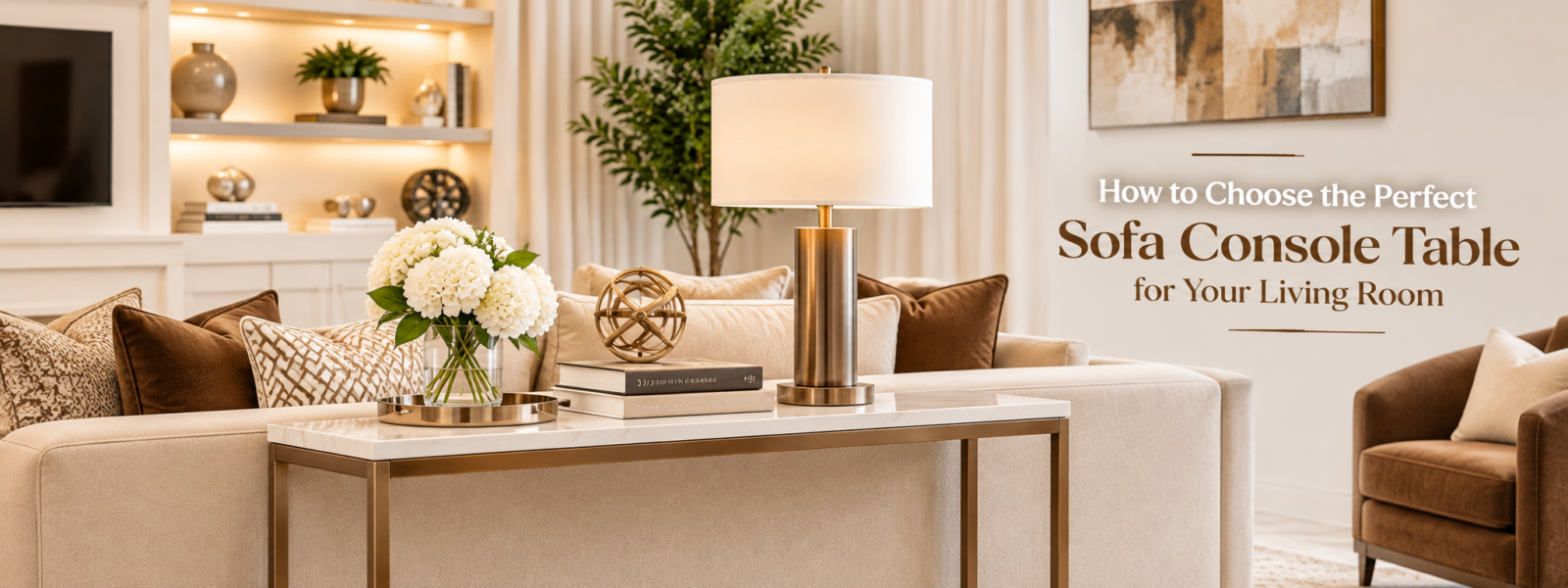
How to Choose the Perfect Sofa Console Table for Your Living Room
Nov
A sofa console table is a slim, practical surface placed behind or beside a sofa. The perfect choice fits the available gap, sits at a useful height, complements your furniture and provides the storage or display space you genuinely need. Measure first, then compare its shape, material and finish.
It can make an awkward strip behind a sofa useful, create a home for a lamp or keep everyday items close without taking up the floor area of a deep cabinet. In compact rooms, the table’s depth matters as much as its appearance because it must leave the main route clear.
Choosing a sofa console table is easiest when you start with the sofa rather than a product photograph. If you are comparing living room furniture at Evans of High Wycombe, note your sofa measurements, the colours already in the room and the job the table needs to do before narrowing down styles.
Table of Contents
- How to Choose the Perfect Sofa Console Table for Your Living Room
- Identify How a Sofa Console Table Enhances Your Living Space
- Measure Your Sofa and Available Space
- Choose a Table Style That Complements Your Interior
- Find the Right Height, Width and Depth
- Select Materials That Balance Style and Durability
- Explore Storage and Space Saving Features
- Match Colours and Finishes with Existing Furniture
- Style the Table with Practical Decorative Accents
- Avoid Common Sofa Console Table Buying Mistakes
- Create a Balanced and Functional Living Room Look
- Sofa Console Table Buying Checklist
- Frequently Asked Questions
How to Choose the Perfect Sofa Console Table for Your Living Room
Start by deciding what the table needs to do. It might provide a surface for a reading lamp, keep a remote and book close at hand, offer discreet storage or give a freestanding sofa a more finished appearance. Once its purpose is clear, check the space and sofa dimensions.
Then consider style, height, depth, construction and storage. Working through these details in order makes it easier to compare options and avoid choosing a table that looks right but does not suit your room.
Identify How a Sofa Console Table Enhances Your Living Space
A console table behind a freestanding sofa can make the exposed back feel more considered. It also gives you a useful place for a lamp, a small decorative object or items you want close while seated. In an open plan room, the table can help define the seating area without creating a solid visual barrier.
If your sofa sits against a wall, a narrow console may work better beside it than behind it. This gives you a surface for everyday essentials while taking up less room than a cabinet or a wide sideboard. Consider how you move through the room before deciding where the table will go.
A console is most useful when it solves a specific problem. If the room is already tight, a deeper table may make the walkway uncomfortable. If you mainly need somewhere to put a drink, a smaller side table could be a better fit.
Measure Your Sofa and Available Space
Measure the sofa from the outside of one arm to the outside of the other. This gives you the overall width to compare with a table. For a corner or chaise sofa, note the length of the straight section where you expect the console to sit, as well as any part that projects into the room.
Measure the gap between the sofa and the wall if the table will sit behind it. Check for skirting boards, radiators, sockets, curtains and any mechanism that moves when the sofa reclines. Leave enough room to reach cables and controls without pushing the table into the upholstery.
Use masking tape to mark the table’s likely footprint on the floor. This makes it easier to see whether its depth will narrow a walking route or interfere with a door. Where the layout allows, aim for a main passage of roughly 75 cm, while prioritising comfortable movement in your particular room.
Choose a Table Style That Complements Your Interior
Use the furniture you already own as a guide. A traditional living room may suit a wooden console with shaped legs or drawer details, while a more contemporary space could work well with a simple frame and clean lines. An open base can help a compact room feel less crowded than a design with solid sides.
The table does not have to match your coffee table or other furniture exactly. Repeating one detail, such as a wood tone, leg shape or metal finish, can make the room feel coordinated without making every piece look like part of a matching set.
Think about the sofa as well as the room’s overall style. A patterned or richly coloured sofa may work best with a quieter table, while a simple sofa can provide a backdrop for a more distinctive console. When comparing living room furniture at Evans of High Wycombe, consider how the table will look alongside the sofa and other pieces you plan to keep.
Find the Right Height, Width and Depth
Height affects both comfort and appearance. A table behind a sofa usually looks balanced when its surface is level with, or slightly below, the back of the sofa. Around 2 to 5 cm lower is a useful starting point, though the sofa’s shape and cushion movement may affect the best fit.
For width, a table around two thirds to three quarters of the sofa’s length often looks well proportioned. A shorter design can be a better choice where a walkway runs close to the sofa. If the table is beside the sofa, compare its height with the arm so you can reach items easily while seated.
Depth should reflect the available gap and intended use. A depth of around 20 to 25 cm may suit a narrow walkway, while a roomier position may allow 30 to 40 cm. Check that the surface can hold what you need without projecting into the route through the room. Treat these measurements as guidance rather than fixed rules.
Select Materials That Balance Style and Durability
Choose the material for both its appearance and how you use the living room. Wood can bring warmth and visible grain, while a metal frame can give a table a lighter, more defined outline. Glass may keep a small room feeling open, but it can show fingerprints and needs careful handling.
Consider the surface as well as the frame. A table used every day for drinks, books or a lamp may need a finish that is straightforward to care for. If you have children or pets, think about how easily the surface marks and whether sharp corners or delicate details are suitable for the room.
Sofa Console Table Selection Guide
| Living Room Requirement | Recommended Table Choice | Useful Size Guide | What to Check Before Buying |
| Filling the space behind a freestanding sofa | A console that complements the sofa’s shape without extending too far at either end | Around two thirds to three quarters of the sofa’s length; surface level with or slightly below the sofa back | Check the gap behind the sofa, cushion movement, recliner controls and access to sockets |
| Keeping a narrow walkway clear | A slim table with a shallow top and open base | Around 20 to 25 cm deep can suit a tighter space | Mark the table’s footprint on the floor and check that the route remains comfortable |
| Adding useful storage in a family living room | A design with drawers, shelves or both | Choose dimensions that fit the gap while allowing drawers to open fully | Check the usable storage space, surface care instructions and stability |
| Placing a table beside the sofa | A compact console that is easy to reach from the seat | A height close to or slightly below the sofa arm | Make sure it does not obstruct the seat, sofa controls or nearby walkway |
| Making a small room feel more open | A shallow design with slim legs or an open frame | Base the depth on the available floor space rather than appearance alone | Consider whether a solid sided table would make the room feel crowded |
| Creating a coordinated interior | A material or finish that echoes details in the sofa, flooring or other furniture | Choose a size that feels proportionate to nearby pieces | Compare finishes in the room’s natural and evening light |
Explore Storage and Space Saving Features
Decide what you want to keep on or inside the table. An open shelf makes books, baskets or a folded throw easy to reach. Drawers can keep smaller items such as remotes and chargers out of sight, giving the surface a tidier appearance.
A combination of drawers and shelves offers both concealed and visible storage, but it can also make a narrow table look heavier. Check the usable shelf space and allow room for drawers to open fully. A drawer that cannot be pulled out because it is too close to the sofa will be of little practical value.
For a table behind the sofa, keep cables tidy and make sure they do not cross a walking route. If you plan to use a lamp or charge a device, check where the nearest socket is and whether the table design gives you a sensible way to manage the cable.
Match Colours and Finishes with Existing Furniture
A coordinated room does not need every wood finish or metal detail to be identical. Instead, look for a connection between the table and the sofa, rug, flooring or nearby furniture. For example, a warm wood surface can sit comfortably with a neutral sofa, while a dark frame might echo a lamp or coffee table.
Pay attention to undertones. Pale woods can look different beside warm beige upholstery than beside cooler grey fabric. If you are unsure, compare a finish sample with the room’s main colours in daylight as well as in the evening.
A contrasting table can add interest when the rest of the room is calm. Keep the contrast deliberate by repeating its colour or material in one or two other details, such as a frame, lamp base or tray. This creates a considered look without forcing an exact match.
Style the Table with Practical Decorative Accents
Leave enough clear space for the table to do its job. A lamp can provide useful light beside the sofa, while a tray keeps small everyday items together. A few books, a small plant or one decorative object can add character without turning the surface into a display shelf.
Vary the height of objects so they do not all form a single row, but avoid placing tall pieces where they block the view across the room. Keep items set back from the edge, particularly if people regularly walk behind the sofa or children and pets use the space.
Think about care as you style the surface. Use a suitable mat or coaster for drinks and protect the top from damp plant pots. If you add a lamp, position its cable safely and make sure the switch is easy to reach from your seat.
Avoid Common Sofa Console Table Buying Mistakes
A common mistake is choosing by appearance alone. Product photographs can make a table look narrower or taller than it is, so check its listed measurements and compare them with your notes. If you cannot find a key dimension, ask before buying rather than estimating from the image.
Do not measure only the sofa’s width. The gap behind it, the walking route, a nearby radiator and the room’s sockets can all affect whether the table works. Check the sofa’s movement too, especially if it reclines or has adjustable parts.
It is also easy to choose more storage than you need or a finish that does not suit everyday use. Think about what will actually sit on the table and how often you will use drawers or shelves. A well chosen narrow console can be more useful than a larger design that makes the room harder to move around.
Create a Balanced and Functional Living Room Look
Once the table is in place, look at the room from the main entrance and from the sofa. The console should relate to the sofa’s width and sit comfortably within the available space. If it is behind a freestanding sofa, it can help define the seating area; beside a sofa, it should remain easy to reach without crowding the seat.
Consider how the table works with the coffee table, side tables and rug. These pieces do not need to match, but their scale and finishes should feel compatible. Keep the route between the seating area and the rest of the room open, and avoid blocking a socket, radiator or natural light.
The best result balances appearance with daily use. A lamp should be within reach, useful items should have a home and the tabletop should still have some clear space. If the console makes the living room feel crowded, reconsider its depth or position before adding more accessories.
Sofa Console Table Buying Checklist
☐ Measure the sofa’s overall width, height and depth.
☐ Measure the gap, nearby fixtures and main walking route.
☐ Check the table’s full height, width and depth against the space.
☐ Decide whether you need drawers, shelves, an open base or a simple surface.
☐ Choose a material and finish suited to your room and daily use.
☐ Check access to sockets, sofa controls and any reclining mechanism.
☐ Confirm product details and delivery access before ordering.
Frequently Asked Questions
How high should a sofa console table be?
A table behind a sofa usually looks balanced when its surface is level with or slightly below the sofa back. Around 2 to 5 cm below is a useful starting point. Compare the actual table height with your sofa, since cushion shape and movement can change the fit.
How wide should a console table be behind a sofa?
A width around two thirds to three quarters of the sofa’s length often looks proportionate. A shorter table may suit a narrow room or a nearby walkway. Make sure the ends do not jut into the route through the living room.
Can I use a sofa console table in a small living room?
Yes, if its depth and position suit the available space. A slim design around 20 to 25 cm deep can provide a useful surface while taking up less floor area. Mark its footprint on the floor first and check that you can still move comfortably around the sofa.
Final Summary
Selecting the right console for your living room comes down to three connected decisions: getting the measurements right, choosing materials built to last, and styling the surface with restraint. Height sets the tone, width establishes proportion, and depth protects the comfort of your room.