Style
How to Style Cushions on Sofa
Sep
Figuring out how to style cushions on sofa can change the entire mood of your living room without spending much money or moving a single piece of furniture. But the process trips up plenty of people. You spot a cushion you love at the store, bring it home, and suddenly it fights with everything else on the couch. Or you arrange them neatly, step back, and the whole setup looks limp and boring instead of relaxed and inviting.
The good news is that you don’t need a design degree to get it right. Learning how to style cushions on a sofa comes down to understanding a few basic ideas about color, scale, and texture. It’s about creating a look that feels intentional rather than accidental. Whether you have a sleek modern sofa or a cozy overstuffed sectional, the right cushion combination can transform the entire feel of your space. Let’s walk through the process step by step, without any of the usual design jargon getting in the way.
Start with a Simple Color Plan
The most common mistake people make is trying to match every cushion perfectly to the rug, the curtains, and the wall art. This usually ends up looking overly stiff and a little boring. Instead of chasing a perfect match, think about creating a cohesive palette using just three colors.
Pick one color to act as your neutral anchor. This is usually a solid, quiet tone like warm beige, soft ivory, charcoal grey, or a textured oatmeal. These cushions give the eye a place to rest and keep the sofa from feeling chaotic.
Next, choose one color that ties the sofa to the rest of the room. If your living room already has hints of deep blue in the artwork or the rug, that blue becomes your secondary color. Use it on one or two cushions to create a visual link.
Finally, add one element of surprise. This could be a metallic sheen, a bold pattern, or a contrasting color like mustard yellow against a grey room. This third piece is what gives the arrangement personality and stops it from feeling like a showroom display.
If your sofa is already a strong color, treat that sofa color as your neutral anchor and build the three color system around it. The goal is harmony, not a color coded spreadsheet.
Choose the Right Sizes for a Balanced, Inviting Space
One of the secrets to a high end look is using the correct cushion sizes. A row of small, standard square cushions lined up like soldiers can actually make a sofa look smaller and cheaper. To create that deep, inviting, sink into it feeling, you need to layer different sizes.
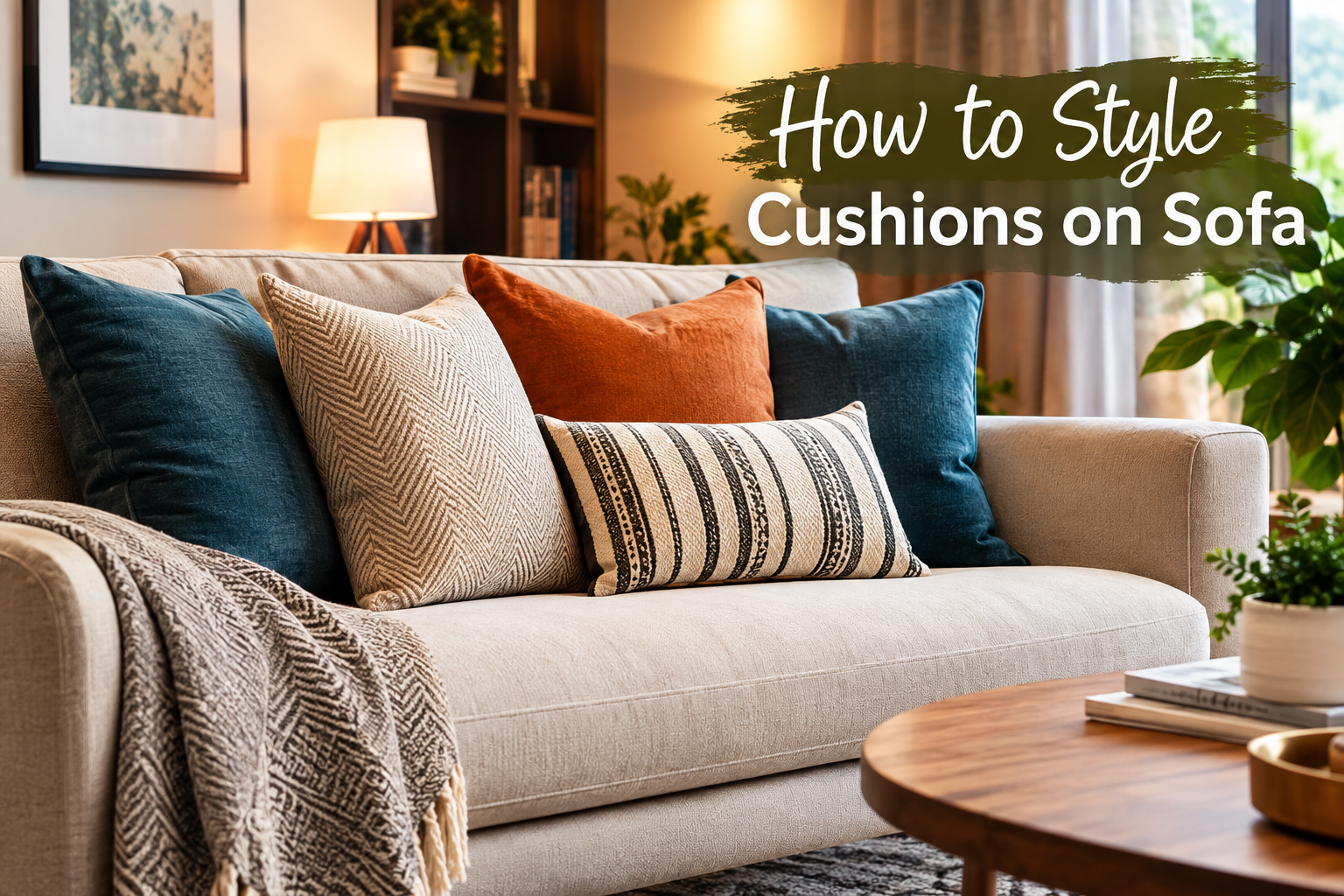
For a standard three seater sofa, work with at least two different dimensions. The most reliable combination is this: two larger cushions (around 22×22 inches or 24×24 inches) placed at the back corners, two medium cushions (18×18 or 20×20 inches) placed in front of them, and one rectangular lumbar pillow (12×20 or 14×22 inches) in the center front.
The larger cushions form a soft wall of support. The medium ones add depth. The lumbar pillow gives a tailored, finished edge. Never line them all up in a flat row against the back of the sofa that defeats the purpose of layering.
If you have a loveseat or a compact apartment sofa, scale down. Two 20×20 inch cushions and one lumbar pillow are often enough. On a big sectional, you can repeat this two large, two medium, one lumbar pattern across different corners to create separate seating zones. The key is layering sizes, not just piling on more of the same.
The Arrangement That Always Works
Now that you have your colors and sizes sorted, how do you actually place them on the sofa? There is one classic arrangement that never fails, and once you learn it, you’ll never wonder about cushion placement again.
Start with your two largest cushions. Place them neatly in the far left and far right corners of the sofa. These should be your neutral anchor colors, the solids or the most textured pieces. Fluff them up so they stand tall.
Next, take your two medium sized cushions. These should be your secondary color or a pattern that includes that color. Place them directly in front of the corner cushions, but don’t center them perfectly. Overlap them slightly toward the middle of the sofa. This little offset creates a sense of depth and makes the arrangement look styled by hand, not by a machine.
Finally, place your lumbar pillow or a smaller square pillow right in the center, slightly forward of the other two. This should be your boldest piece, the pattern, the metallic, or the pop of contrast. It breaks up the symmetry and draws the eye to the middle of the sofa.
If you prefer a more relaxed, asymmetrical look, try placing two large cushions on one side and one large plus one lumbar on the other. This works especially well on sectionals or when you want to steer guests toward a particular seat. But for most standard sofas, the “two large, two medium, one center” method is the easiest way to get a polished result.
Mixing Prints and Fabrics Without Fear
This is where a lot of people freeze up. Mixing patterns can feel risky, but there is a simple trick that removes the guesswork: vary the scale and keep the colors consistent.
If you decide to use two patterned cushions, never let them be the same size print. Pair a large scale floral or geometric design with a small scale stripe or polka dot. If both patterns are the same visual weight, they will clash and look busy. One big, one small that’s the rule.
Texture matters just as much as pattern, maybe more. Even if you stick to a completely neutral palette (all whites, all beiges, all greys), texture is what stops the sofa from looking flat and lifeless. Mix a smooth velvet cushion with a chunky boucle one. Add a soft faux fur piece next to a crisp linen cover. A leather cushion can also work beautifully, breaking up all that soft fabric with an organic, slightly rugged element.
Aim for at least three different textures on your sofa. For example: a woven wool cushion (textured neutral), a smooth velvet cushion (smooth secondary color), and a shaggy or embroidered cushion (tactile pop). That contrast between rough and smooth, shiny and matte, is what makes a sofa look expensive and professionally curated, without spending a fortune.
The Final Fluff: Shaping Cushions So They Look Lived In but Luxe
You can buy the most beautiful cushions in the world, but if you don’t shape them properly, they will look flat and sad. The most important technique to know is often called the “karate chop,” and it takes about five seconds per cushion.
Instead of leaving a square cushion looking perfectly square and boxy, use the side of your hand to press down firmly into the top center of the cushion. This creates a soft “V” shape or a little peak at the top. Instantly, the cushion looks fuller and more relaxed, like someone actually lives there and enjoys sitting on the sofa. For down or feather filled cushions, this chop is essential to keep them from going limp. For polyester filled cushions, fluff them by hand first, push the filling toward the center, then give a gentle chop. You may need to re-fluff every few days, which is normal.
Finally, don’t overstuff the sofa. It’s tempting to keep adding cushions, but you need to leave actual room for people to sit down. A good guideline is that your cushion arrangement should take up no more than about one third of the sofa’s width. If you have to move five cushions just to find a seat, you’ve gone too far. The goal is a sofa that looks inviting and comfortable, not like a museum display where touching is forbidden.