Style
Why the Shape of a Dining Chair Matters for Comfort and Room Style
Oct
A dining chair is more than a place to sit. It is the piece of furniture you interact with most intimately during meals, conversations, celebrations and quiet moments at home. Yet many people choose dining chairs based on colour or fabric alone, overlooking the single most important factor that determines whether a chair will feel good after a few minutes or a few hours: its shape.
The silhouette of a dining chair, from the curve of its backrest to the depth of its seat, governs how your body is supported and how the chair relates to the wider room. Understanding this relationship is the key to making a purchase you will be happy with for years.
At Evans of High Wycombe, furniture has been handmade in Buckinghamshire for generations, and the company’s own exclusive range of tailor made sofas and chairs reflects decades of experience in getting shape right. This guide explores how the shape of a dining chair affects comfort, posture and the visual harmony of your dining space, and it explains what to look for when you visit a showroom to choose your next set.
Shape Is the Foundation of Both Comfort and Style
The shape of a dining chair matters because it determines how your body is supported during sitting and how the chair interacts visually with your table and room. A well shaped chair distributes your weight across the seat and backrest, encourages a natural spinal curve and allows you to sit for extended periods without discomfort.
At the same time, the contour of the backrest, the width of the seat and the line of the legs influence whether a dining space feels open or crowded, formal or relaxed. In short, shape is the common ground where ergonomics and interior design meet, and it is the aspect to evaluate before considering fabric or finish.
How Seat Shape Affects Comfort
Seat depth is the measurement from the front edge of the seat to the backrest. When depth is correct, the seat supports the full length of your thighs without pressing against the back of your knees. A seat that is too deep forces you to perch on the front edge, leaving your back unsupported. A seat that is too shallow concentrates pressure on a small area and can cause numbness during longer meals. Ergonomics guidance suggests that the front edge of the seat should curve downwards and end roughly a few finger widths behind the knees, allowing circulation to continue freely.
For most adults, a moderate seat depth provides a comfortable balance, though taller individuals may benefit from slightly deeper seats and shorter individuals from shallower ones. This is a reason why bespoke dining chairs, made to the proportions of the people who will use them, offer a level of comfort that standard sized chairs cannot match.
Seat Height and the Sitting Angle
Seat height determines the angle at which your hips and knees rest. When seated, your hips should be slightly higher than your knees, with your feet resting comfortably on the floor or on a footrest. A seat height that is too low causes the knees to rise above the hips, tilting the pelvis backwards and flattening the natural curve of the spine. A seat height that is too high leaves the feet dangling, which creates pressure behind the thighs and makes it difficult to sit back into the chair.
Most dining tables stand at a standard height, and a chair seat height within a complementary range pairs well with this. The precise figure depends on your table and your body, which is why measuring both before choosing a chair is always worthwhile.
Seat Contour and Weight Distribution
The surface of the seat is not a flat plane in a well designed chair. A subtle bowl shape, sometimes described as a scoop or a gentle depression, helps distribute body weight across a wider area and reduces pressure points around the sit bones. Research into dining chair design has shown that a bowl shaped seat base can be engineered to fit the vast majority of body types, improving comfort during long dinners. A contoured seat also discourages the forward sliding that occurs when a flat seat is paired with a reclined backrest, keeping the sitter stable and relaxed.
For households where people sit in different ways, from upright dining posture to a more relaxed lean, a gently contoured seat offers versatility. Some chairs extend the rear of the seat slightly and slope it smoothly to accommodate deeper sitting positions without creating a gap between the seat and the backrest.
The Backrest: Where Posture Meets Support
The angle between the seat and the backrest is among the most important measurements in dining chair design. A seat to back angle that is too upright forces the spine into a rigid position and quickly becomes tiring. An angle that is too reclined may feel comfortable at first but makes it difficult to reach the table and encourages slouching. Ergonomics recommendations place the ideal angle at a slightly reclined position, a range that supports the natural S curve of the spine while keeping the sitter engaged with the table.
This angle is not a matter of guesswork in a well made chair. It is the result of careful design, and it is a detail that distinguishes a chair built for real life from one built only to look good in a photograph.
Lumbar Support and the Curve of the Back
The lower back, or lumbar region, needs support to maintain its natural inward curve. A backrest that is flat or that curves only at the top leaves the lumbar area unsupported, and the sitter’s spine gradually rounds forward. A backrest with a gentle curve in the lower section provides lumbar support and reduces the strain that builds during extended sitting.
The contact point that carries the most weight on a backrest benefits from a slightly larger curvature, which optimises both comfort and stability. This is not about forcing the body into a particular posture. It is about giving the body a shape to rest against so that the muscles of the back do not have to work constantly to hold the torso upright.
Backrest Height and Its Effect on Movement
Backrest height influences both support and freedom of movement. A low backrest that reaches only the lower or mid back allows the shoulders and upper back to move freely, which is useful in a dining setting where people turn to speak to each other. A high backrest that extends to the shoulder blades or above provides more comprehensive support and can create a sense of enclosure, which some people find comforting during longer meals.
There is no single correct backrest height for every dining room. A low backed chair suits a compact space or a table where conversation flows around the room. A higher backed chair suits a formal dining room or a setting where people linger. What matters is that the height of the backrest is matched to the way the chair will be used.
The Shape of the Backrest Frame
The frame of the backrest can be solid, open, curved or angled. A solid upholstered back offers the softest contact and the most even pressure distribution. An open back, whether made from spindles, slats, cane or a single curved piece of wood, allows light and air to pass through, which makes the chair feel lighter in a room and can be more comfortable in warm weather.
A curved back that wraps slightly around the sides of the torso provides a gentle sense of support without restricting movement, and it often pairs beautifully with round or oval dining tables because the curves echo each other.
The choice between these options is partly practical and partly aesthetic. An open back is easier to move and can make a small dining area feel less crowded. A solid back offers more upholstery options and can introduce colour and texture into the room. Many well designed dining sets combine the two, using an upholstered back for the head of the table and an open back for the sides.
Armrests: Comfort, Access and Proportion
Armrests are a feature that divides opinion in dining chair design. On one hand, armrests provide support for the forearms and make it easier to stand up from the table, particularly for older diners or anyone who finds it uncomfortable to push up from a chair without support. On the other hand, armrests add width to a chair, and they can prevent the chair from tucking fully under the table, which reduces the number of seats that will fit along a given table length.
The shape of the armrest matters as much as its presence. A gently curved armrest that flows from the backrest and slopes downwards towards the front supports the forearm in a natural position and allows the sitter to rise easily. A straight, boxy armrest can dig into the underside of the table and feels less inviting. For dining rooms where space is generous, armed chairs at the heads of the table and armless chairs along the sides create a balanced arrangement that combines comfort with efficient use of space.
How Shape Influences Room Style
The shape of a dining chair affects the visual weight it carries in a room. A chair with a slender frame, tapered legs and an open back reads as light and airy, which helps a small dining area feel more spacious. A chair with a solid upholstered back, a broader seat and more substantial legs carries more visual weight, which suits a larger room or a table with a heavy top. The goal is not to make every chair disappear, but to choose a shape whose visual weight sits comfortably alongside the table and the surrounding furniture.
A delicate bistro table is overwhelmed by a chunky, high backed chair, just as a substantial farmhouse table can make a slim, minimalist chair look fragile. Matching the scale of the chair to the scale of the table is among the simplest ways to create a harmonious dining space.
Shape and Table Geometry
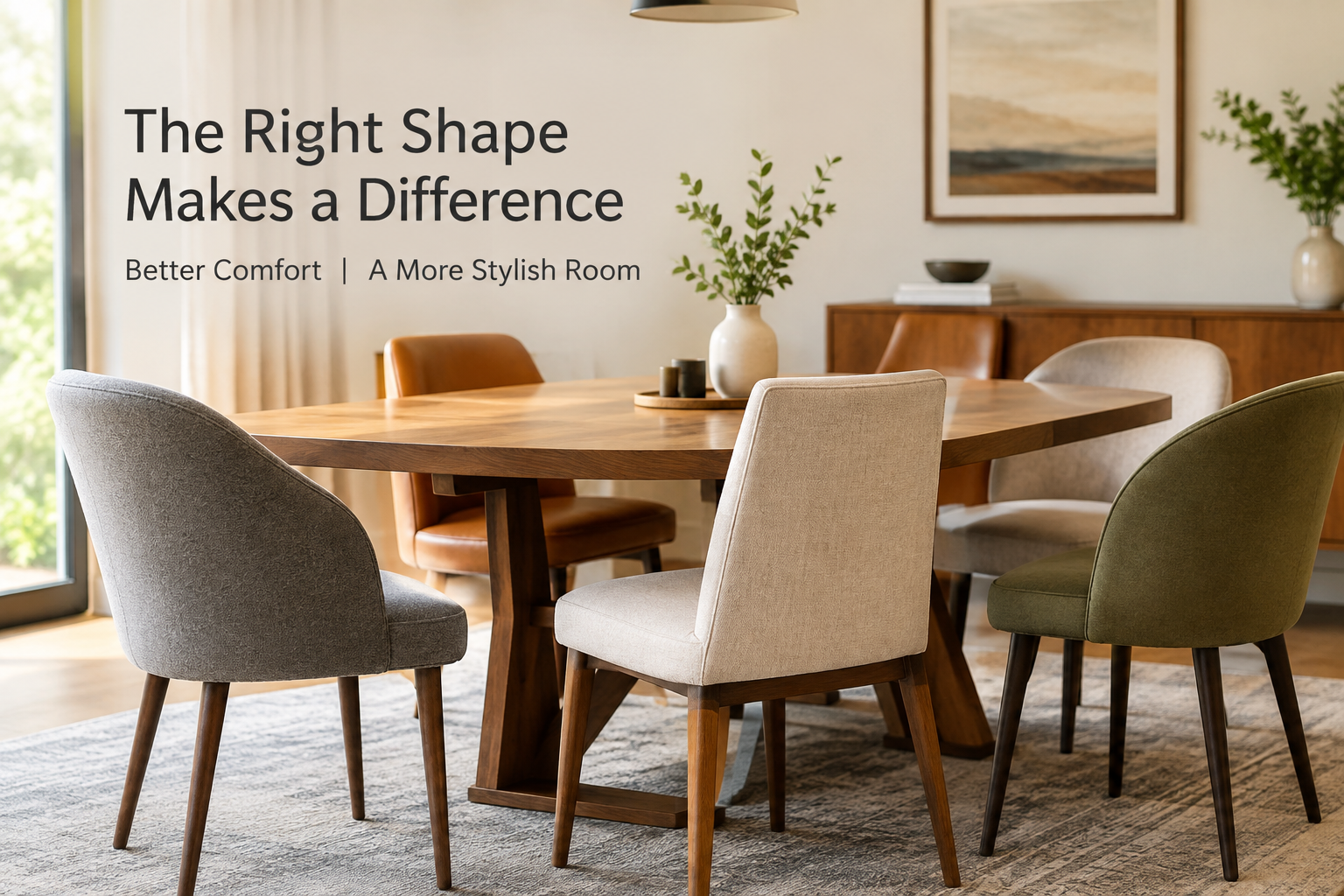
The geometry of the dining table offers a clear guide for choosing chair shapes. Rectangular and square tables have straight lines and sharp corners, and they pair naturally with chairs that share that crisp, clean profile. Oval and round tables have softer contours, and they are complemented by chairs with curved backs and rounded seats that echo the shape of the table.
This principle extends to the arrangement of the chairs around the table. A round table with curved chairs creates a circular rhythm that feels balanced and sociable. A rectangular table with straight backed chairs creates a more formal, structured look. Neither approach is better than the other, but consistency between the shape of the table and the shape of the chairs gives a room a sense of intention that is immediately visible.
Shape and the Feeling of Space
In a narrow dining room or an open plan living and dining area, the shape of the dining chairs has a direct impact on how spacious the room feels. Chairs with open backs allow sightlines to pass through them, so the eye travels further and the room feels larger.
Chairs with solid backs create visual barriers that can make a compact space feel closed in. Similarly, curved shapes are generally more forgiving in tight spaces than sharp, angular forms, because the absence of hard corners makes it easier to move around the table.
This does not mean that solid backed chairs have no place in a smaller room. An upholstered back can add warmth and softness that a purely open chair cannot provide. The key is to balance the visual weight of the chair with the size of the room and to consider how the chairs look when they are pushed in and when they are pulled out.
Materials and Upholstery
The material of the chair frame contributes to both its shape and its durability. Solid hardwood frames, such as beech or oak, can be shaped into curves and tapers that are difficult to achieve with softer woods, and they hold their form over years of use. The shape of the frame determines how the chair sits on the floor, how stable it feels when you lean back and how gracefully it ages.
A well made wooden frame is also repairable, which is an important consideration for furniture that is intended to last. The shape of the joints, whether traditional mortise and tenon or a modern equivalent, influences the strength and longevity of the chair just as much as the visible silhouette.
Upholstery and the Softness of Shape
Upholstery adds a layer of softness to the shape of a dining chair. A padded seat cushions the sit bones and reduces the pressure that builds during a long meal. A padded backrest provides a softer contact surface and can be shaped to follow the curves of the body more closely than a rigid wooden back.
The thickness and firmness of the padding matter. Padding that is too thin offers little relief, while padding that is too thick can make the chair feel bulky and can alter the effective seat height and depth. A moderate level of padding, firm enough to support and soft enough to comfort, is the goal. High density foam retains its shape better than lower density alternatives and is a sign of a chair built to last.
Fabric and the Visual Shape of the Chair
The fabric or leather chosen for a dining chair affects how its shape is perceived. A smooth, tightly woven fabric emphasises the line of the chair and makes curves look crisp and defined. A textured fabric, such as boucle or a loose weave, softens the silhouette and adds a sense of warmth.
A patterned fabric can draw attention to the shape of the backrest or the curve of the seat, using the chair as a decorative element in the room.
For households with young children or frequent entertaining, performance fabrics and easy to clean upholstery options allow the comfort benefits of a padded chair without the worry of spills and stains. The shape of the chair remains the same, but the choice of covering determines how practical and how visually striking it will be in daily life.
Choosing Dining Chairs for Different Rooms
A formal dining room calls for chairs that feel substantial and supportive. A higher backrest, a gently curved seat and a considered seat to back angle create a chair that encourages diners to linger. Upholstered backs and seats in a fabric that complements the table and the room’s colour scheme add a sense of occasion. Armrests at the head of the table provide a subtle hierarchy that suits formal entertaining, while armless chairs along the sides keep the arrangement balanced.
The shape of the chair should echo the formality of the table without becoming rigid. A gentle curve in the backrest softens the overall impression and makes the chair more comfortable for long dinners.
Casual and Open Plan Dining Areas
In a casual dining area or an open plan kitchen and dining space, the shape of the chair should prioritise flexibility and ease of movement. Chairs with open backs and light frames can be moved easily, stacked if necessary and arranged in different configurations as the occasion demands. A moderately padded seat provides comfort for everyday meals without the bulk of a fully upholstered chair.
Curved backrests work particularly well in open plan spaces because they soften the transition between the dining area and the living area. The absence of hard angles makes the furniture feel more integrated with the rest of the room and less like a separate zone.
Compact Dining Spaces
In a compact dining space, every centimetre matters. Chairs with a shallow seat depth and a narrow frame allow more seats to fit around a small table. Armless designs that tuck fully under the table keep the floor area clear when the chairs are not in use. Open backs allow light to pass through and make the space feel less enclosed.
A curved backrest can be an asset in a small room because it provides support without adding bulk. The curve follows the natural shape of the body, so the chair can be comfortable without being wide. This is a clear example of how shape serves both comfort and spatial efficiency at the same time.
The Bespoke Advantage: When Shape Is Made for You
Standard sized dining chairs are designed to suit an average, and averages rarely fit anyone perfectly. A bespoke dining chair is shaped to the proportions of the people who will use it, from the height of the seat to the depth of the seat and the curve of the backrest. This is particularly valuable in households where family members differ significantly in height, or where a dining chair is used for long periods for work, hobbies or entertaining.
At Evans of High Wycombe, the company’s own range of tailor made sofas and chairs is handmade in High Wycombe, and the same approach can be applied to dining chairs to ensure that the shape of the chair supports the body that will sit in it. A bespoke chair is not simply a luxury. It is a practical response to the fact that comfort depends on fit, and fit depends on shape.
The showroom experience is an important part of this process. Sitting in a chair, feeling the height of the seat, the angle of the backrest and the support of the lumbar curve, is the only way to know whether a shape suits you. A chair that looks beautiful in a photograph may feel entirely different when you sit in it, and a chair that appears plain at first glance may turn out to be the most comfortable seat in the house.
When you choose dining chairs, the shape you select will influence every meal, every conversation and every gathering that takes place around your table. This is why the decision deserves time and attention.
Balancing Comfort and Style: A Practical Approach
Choosing the right dining chairs is a process of balancing comfort and style, and shape is the thread that connects the two. A chair that supports the body well but looks out of place in the room will never feel quite right. A chair that looks perfect but leaves you shifting in your seat after a short while will quickly lose its appeal.
The most successful dining chair choices begin with comfort. Sit in the chair. Feel where the seat supports your thighs and where the backrest meets your spine. Check that your feet reach the floor and that your hips sit slightly above your knees. Then consider how the shape of the chair relates to the table and the room. Does the scale feel right? Does the curve of the backrest echo the curve of the table? Does the chair feel like it belongs in the space?
When comfort and style are both satisfied, the shape of the chair disappears into the background and all that remains is the pleasure of sitting down to a meal in a space that feels exactly right.
Caring for Shaped Dining Chairs
The shape of a dining chair affects how it should be cared for. Curved surfaces and upholstered backs collect dust in different places than flat surfaces, and the joints where the backrest meets the seat can be areas where dirt accumulates. Regular gentle cleaning with a soft cloth and a suitable product for the frame material keeps the chair looking its best.
For upholstered chairs, vacuuming with a soft brush attachment removes dust from the fabric and helps maintain the appearance of the shape. Spills should be blotted rather than rubbed, and performance fabrics can usually be cleaned with a damp cloth. Wooden frames benefit from occasional polishing with a product that suits the finish, taking care to work along the grain and into any curves.
The better a chair is cared for, the longer its shape will remain true, and the longer it will continue to provide the comfort and visual pleasure that made it the right choice in the first place.
Conclusion
The shape of a dining chair is not a detail to be overlooked in favour of colour or trend. It is the foundation of comfort, the expression of style and the element that ties a dining space together. From the depth of the seat to the curve of the backrest, every contour has a purpose, and every purpose is connected to the body that will sit in the chair and the room that will contain it.
At Evans of High Wycombe, furniture has been made by hand in Buckinghamshire for generations, and the company’s showrooms display a wide range of dining furniture alongside its own tailor made collections. Whether you are furnishing a formal dining room, a compact kitchen dining area or an open plan space, the right shape is waiting to be found. Visit the showroom, sit in the chairs and feel the difference that thoughtful shape makes. Comfort and style are not opposites. They are both sides of the same well designed chair.